YOLOv12 Steel Surface Defect Detection
Train an Ultralytics YOLOv12 steel-surface defect detector on NEU-DET: 6 defect classes, ~5000 images, full train → val → predict pipeline for automated steel quality inspection. A reproducible recipe + an illustrative inference demo.
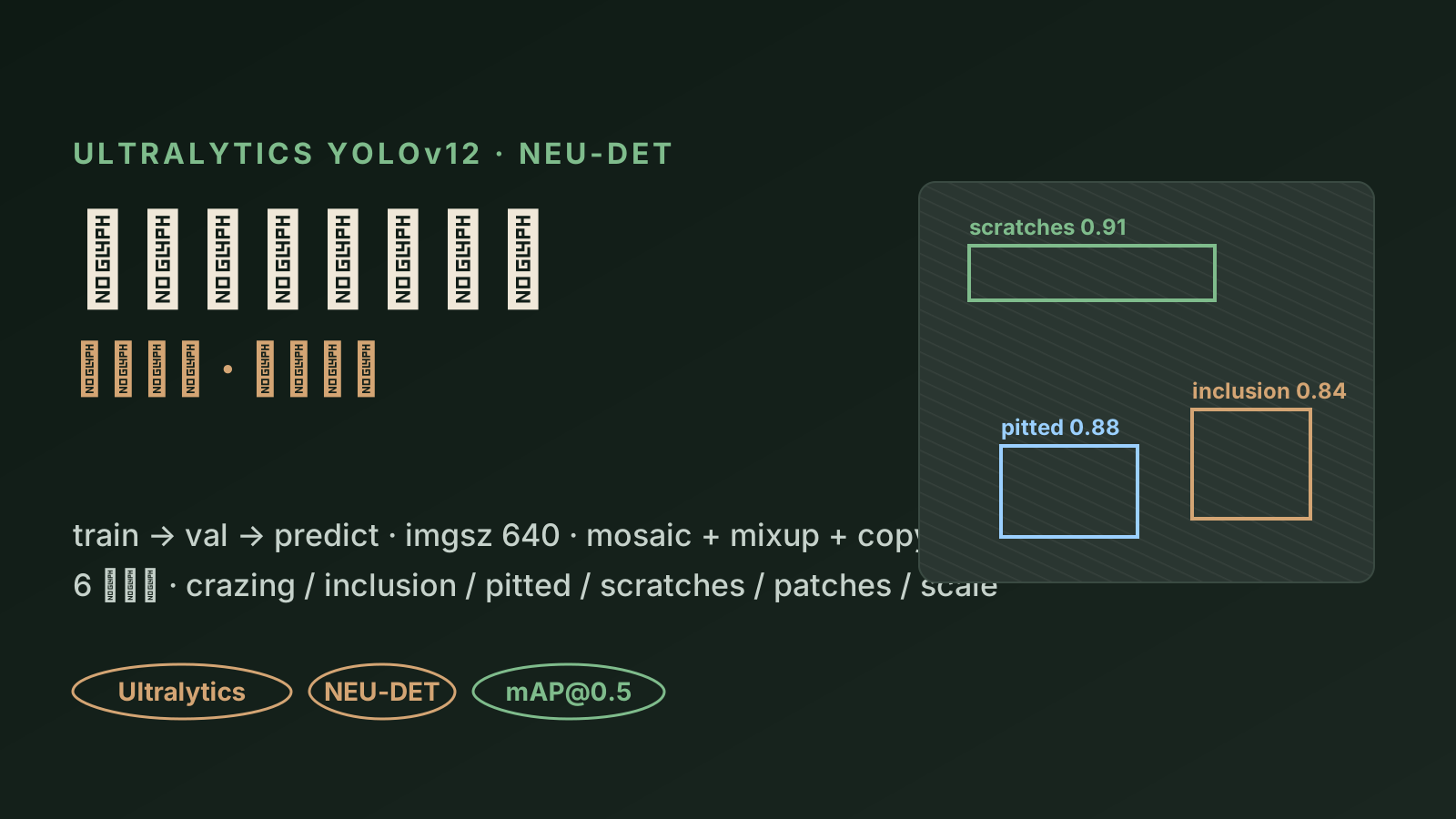
A mill inspector staring at moving steel coils for scratches, inclusions, and pits gets tired and misses things. This project automates that with Ultralytics YOLOv12, training an object detector on the public NEU-DET dataset: a steel-surface image goes in, the model draws boxes over defects with a class label and confidence.
The task
NEU-DET (Northeastern University surface-defect database for hot-rolled steel strip) is a classic industrial-vision benchmark with 6 defect classes:
| Class | Meaning |
|---|---|
crazing | fine crack network — the hardest class to detect |
inclusion | foreign-material inclusions |
pitted_surface | pitting / point corrosion |
scratches | scratches |
patches | surface patches |
rolled-in_scale | rolled-in oxide scale |
About ~5000 grayscale steel-surface images, each with YOLO-format labels (class + normalized xywh). This is object detection, not just "defect / no defect" classification — the model has to locate where the defect is and decide which class.
Data config (dataset.yaml)
Ultralytics describes a dataset with a single dataset.yaml declaring the train/val paths and the
class-name order:
path: ./NEU-DET
train: images/train
val: images/val

names:
  0: crazing
  1: inclusion
  2: pitted_surface
  3: patches
  4: scratches
  5: rolled-in_scale
The order in names is the class index used in the label files — get it wrong and the whole run
is silently mislabeled, so this is the first thing to verify.
Training recipe (3-yolo-steel.py)
The pipeline is three stages — train → val → predict — all on Ultralytics' high-level API:
from ultralytics import YOLO

# 1. Load YOLOv12 pretrained weights for transfer learning
model = YOLO("yolov12n.pt")

# 2. Train on NEU-DET
model.train(
    data="dataset.yaml",
    epochs=100,
    imgsz=640,
    mosaic=1.0,        # stitch 4 images — boosts small-object + context variety
    mixup=0.1,         # linear image blending
    copy_paste=0.1,    # cut instances out and paste them onto other images
)

# 3. Evaluate on the val split → mAP / per-class AP
metrics = model.val()

# 4. Inference on held-out steel images
results = model.predict("samples/steel_held_out.jpg", conf=0.25)
results[0].show()      # overlay boxes
Key settings:
imgsz=640— bigger images make small defects clearer; 640 is the usual speed/accuracy balancemosaic + mixup + copy-paste— defect samples are naturally imbalanced (many scratches, few crazing), so augmentation pads the minority classes and improves generalizationepochs≈100— starting from pretrained weights, a single domain like steel converges fastconf=0.25— inference threshold: raise it and you miss defects (recall ↓), lower it and you over-flag (precision ↓); QC scenarios usually favor recall
Training ran on an AutoDL GPU, producing best.pt (the highest-val-mAP checkpoint), which
inference then loads.
Why YOLO instead of a two-stage detector
| Dimension | Why YOLO |
|---|---|
| Speed | single-stage, end-to-end — coils move fast on the line, so detection must be real-time |
| Sufficient | for regular surface defects like NEU-DET, YOLO accuracy is enough; no Faster R-CNN two-stage overhead needed |
| Ecosystem | Ultralytics wraps train/val/predict/export, so it's one line from training to ONNX/TensorRT deployment |
What this signals
- You can run end-to-end industrial CV: data config → training → evaluation → inference, not just calling a classification API
- It's a real deployment scenario — automated steel-surface QC with 6 named defect classes and a clear production motivation
- It complements the VLM / RAG projects in the portfolio: this is the first object-detection / industrial-CV project, filling in the classical-CV lane
What the demo maps to
The training data (NEU-DET, ~5000 images) and the training code (3-yolo-steel.py / dataset.yaml) are real, from the course; but the trained best.pt weights are NOT shipped with the site, and no model runs in the browser. So this is framed as a reproducible training recipe + an illustrative inference demo: the defect boxes, confidence scores, and per-class AP in the interactive demo are representative of a typical NEU-DET YOLO run (labeled illustrative), not a measured benchmark from shipped weights.