YOLOv12 Steel Surface Defect Detection
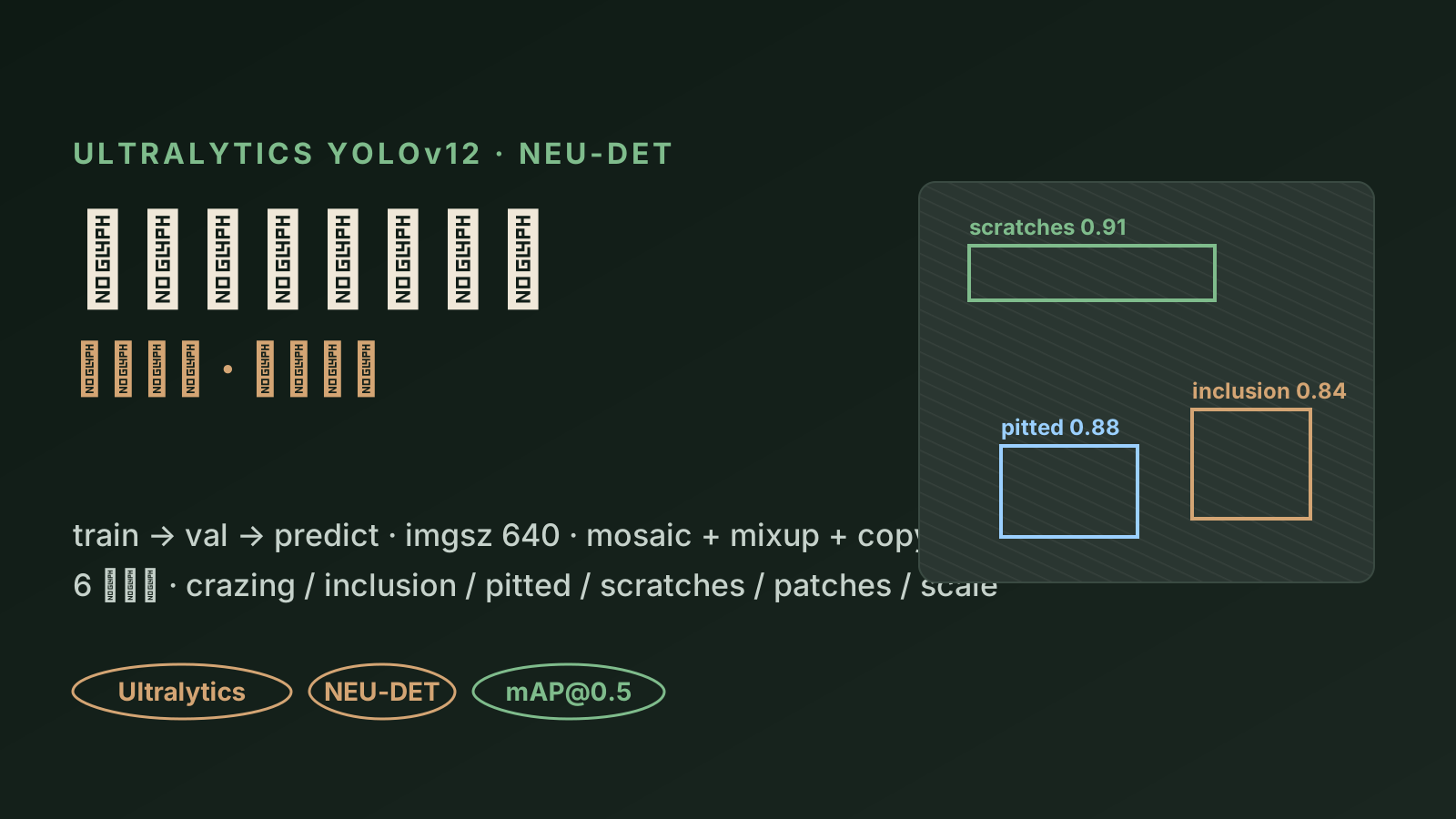
An Ultralytics YOLOv12 detector trained on NEU-DET: 6 defect classes, ~5000 images, full train → val → predict pipeline for automated steel quality inspection. A reproducible recipe + an illustrative inference demo.
Pick a steel-surface image and replay the trained best.pt: YOLOv12 loads, runs one forward pass, and defect boxes (class + confidence) land on the surface, ending in a per-class AP@0.5 table.
Why this local version exists
The training data (NEU-DET, ~5000 images) and code (3-yolo-steel.py / dataset.yaml) are real from the course, but best.pt weights are not shipped and no model runs in the browser. The boxes, scores, and per-class AP are representative of a typical NEU-DET YOLO run — labeled illustrative, not measured from shipped weights.
Run YOLOv12 steel-defect detection
Pick a steel-surface image and replay best.pt inference: defect boxes + per-class confidence appear, ending in an mAP / per-class AP table.
Input image
best.pt → YOLO("best.pt")
Ultralytics loads the YOLOv12 weights trained on NEU-DET (6 classes, imgsz 640).
model.predict(img, conf=0.25)
A single forward pass over the held-out steel image returns boxes + class + confidence.
results[0].boxes → overlay
Detections are drawn over the surface, then summarized into a per-class mAP table.
Training recipe
NEU-DET ~5000 imgs → train / val / predict. ~100 epochs, imgsz 640, mosaic + mixup + copy-paste augments, trained on an AutoDL GPU.
Activity log
Run inference to watch defect boxes land on the steel surface.
Detection overlay
* Boxes + scores are illustrative; best.pt weights are not shipped and no model runs in the browser.
What to try
Switch between the three sample steel images and re-run inference.
Watch the load → predict → overlay stages light up, then boxes appear with per-class labels.
Read the per-class AP@0.5 table — note crazing is the known low-recall hard class.
What this demo proves
You can run end-to-end industrial CV: dataset.yaml → training → val → inference, not just a classification API.
You know the object-detection levers: imgsz, conf threshold, and mosaic/mixup/copy-paste for imbalanced defect classes.
You picked YOLO deliberately — single-stage real-time detection fits a moving production line.
Model
Ultralytics YOLOv12 · transfer from yolov12n.pt · imgsz 640
Dataset
NEU-DET · ~5000 imgs · 6 classes (crazing / inclusion / pitted / scratches / patches / scale)
Pipeline
train → val (mAP) → predict(best.pt) on an AutoDL GPU