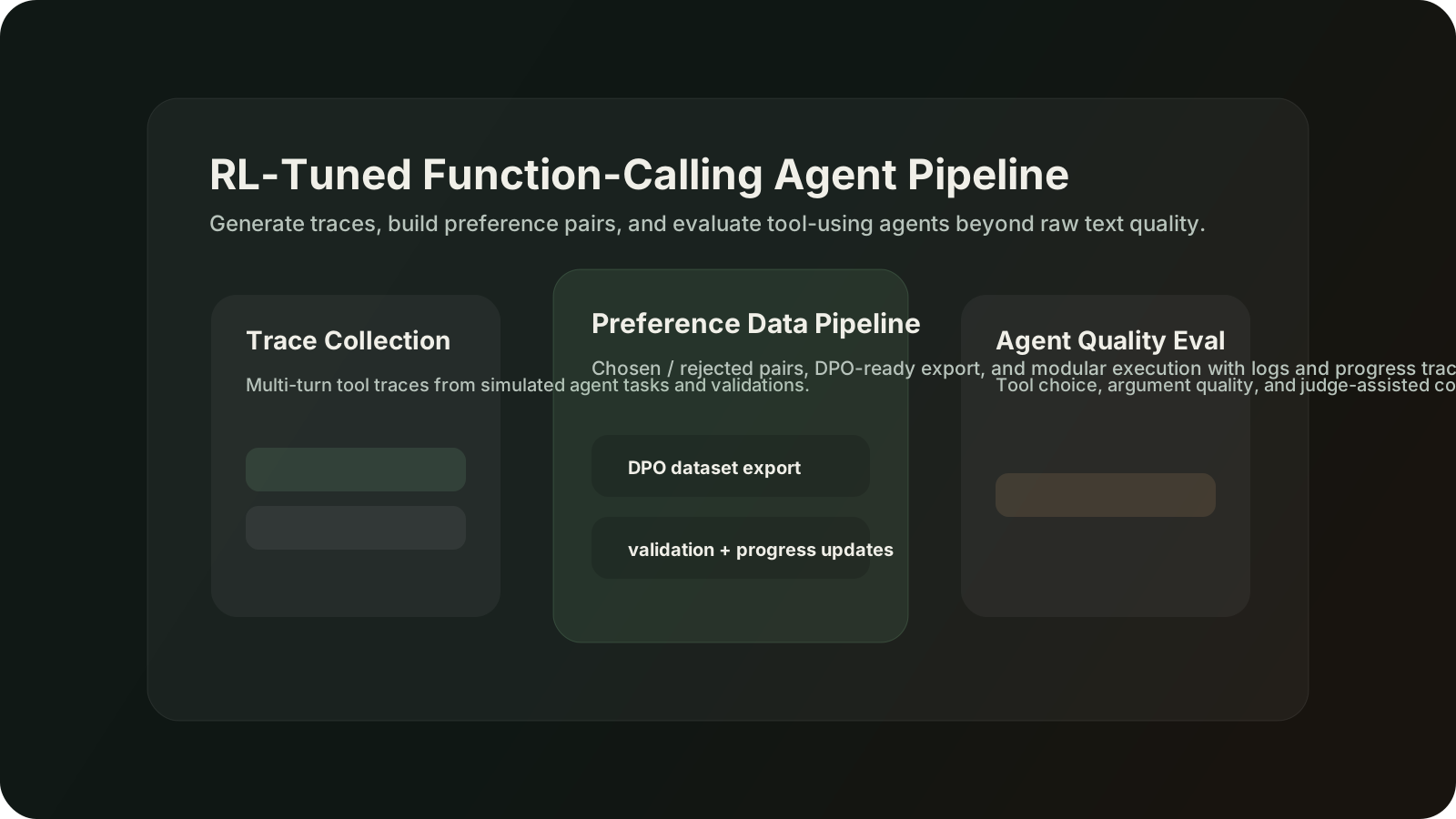
RL-Tuned Function-Calling Agent Pipeline
A preference-data and evaluation pipeline for function-calling agents, focused on improving tool-use decisions instead of raw text formatting.
This project works especially well as a compact but high-signal portfolio item because it shows advanced agent quality thinking: traces, preference pairs, and evaluation criteria tied to decision quality.
Overview
Function-calling agents are not only judged by the text they generate. They are judged by whether they choose the right tool, pass the right arguments, and take efficient action sequences.
This project was designed around that idea. Instead of stopping at supervised examples, it builds a data-generation and evaluation loop for agent optimization:
- collect multi-turn traces from tool-using runs
- construct chosen and rejected preference pairs
- export DPO-ready datasets
- compare base and tuned models on tool-use behavior
Why This Is a Valuable Portfolio Project
Many AI portfolios show agents that can call tools. Far fewer show a workflow for measuring and improving how those agents make decisions.
That is what makes this project useful in interviews. It signals that I am thinking about agent quality as a systems problem, not just a prompt-design problem.
Pipeline Design
The system is organized around modular stages:
- task generation for agent scenarios
- trace collection from tool-using runs
- validation and logging
- chosen / rejected pair construction
- evaluation of tool-call correctness and argument quality
FastAPI and WebSocket-based progress reporting make the workflow easier to operate than a purely offline script bundle.
Best Demo Format
The strongest public demo for this project would be:
- a small set of sample tasks
- replay views of tool traces
- side-by-side comparison of weaker vs. stronger agent behavior
- simple metrics or judge summaries for tool-call quality
That gives visitors a concrete way to understand what “agent tuning” means in practice.
Live demo · AutoToolDPO real chosen/rejected samples
The interactive demo shows the project's real generated dataset verbatim: 3 DPO samples taken from cells 47 and 68 of 案例9 notebook 企业级Agent Function-Calling RL微调.ipynb, with versioned tool names (@v1), <function_call> / <final> tag format, the 'why this is rejected' rationale per sample, and the 6-stage FastAPI + asyncio.Semaphore(10) backend pipeline.
What This Project Signals
- advanced agent workflow understanding
- evaluation-first thinking
- data generation for preference optimization
- applied AI engineering beyond standard prompt-and-demo projects