Harness Engineering in Practice
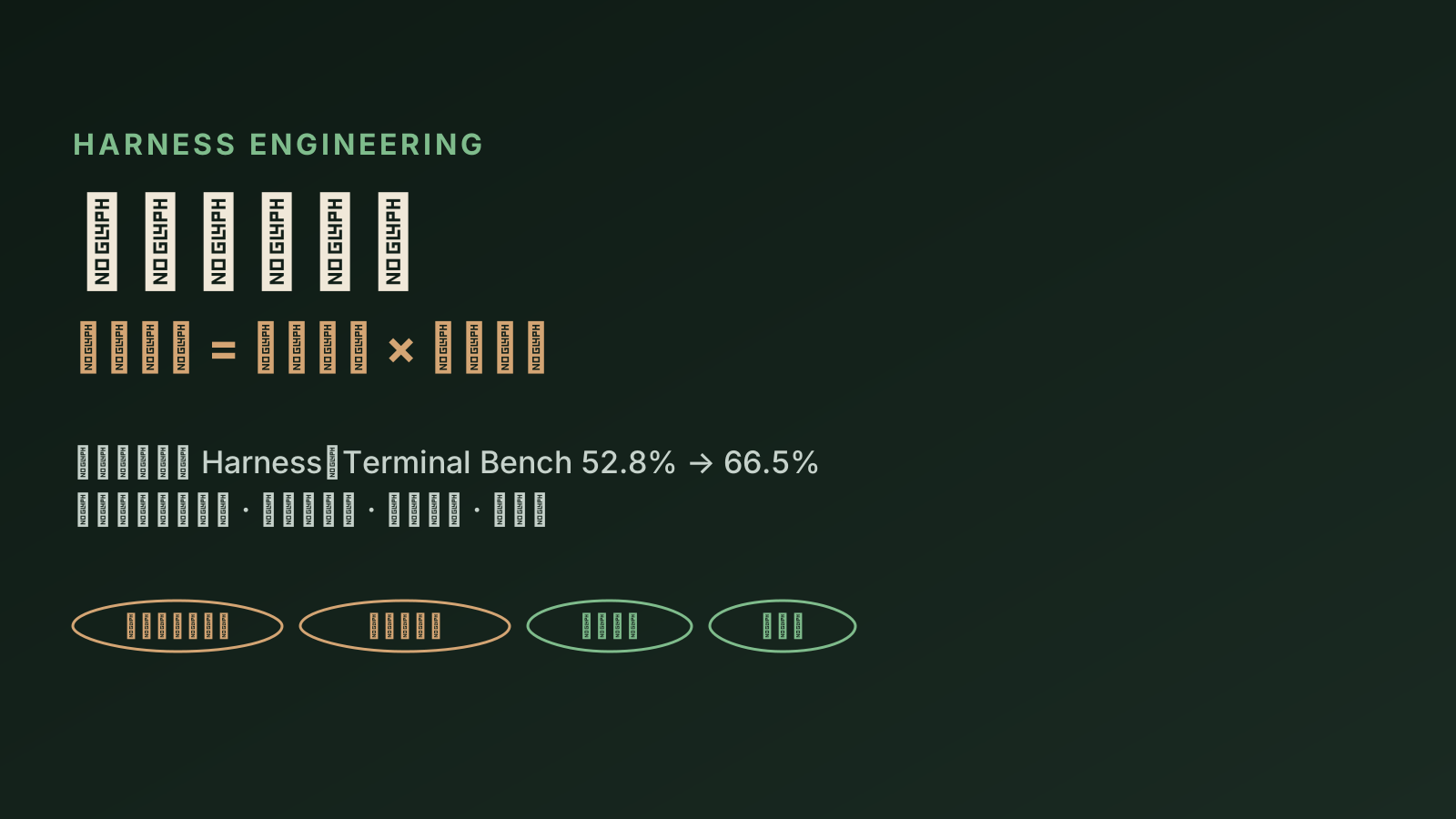
Output quality = model capability × design level. This is about engineering an agent's runtime environment — four pillars (codebase as truth / mechanized constraints / feedback loops / entropy management). Measured: model unchanged, the Harness alone lifts Terminal Bench from 52.8% to 66.5%.
Everyone benchmarks models, but the same model produces wildly different results in different hands — the difference is the Harness. One-line definition: the engineering discipline of designing, building, and continuously optimizing an AI agent's runtime environment. Analogy: "the Harness is to an AI agent what the operating system is to a CPU."
The core formula
Agent output quality = model capability × design level
You can't move model capability (just use the SOTA model), but design level is pure engineering. The course's most striking data point:
| Configuration | Terminal Bench 2.0 | Note |
|---|---|---|
| Bare model (GPT-5.2-Codex) | 52.8% | rank 30+ |
| Same model + full Harness | 66.5% | Top 5 |
Only the Harness changed (system prompt + tools + middleware Hooks); not one line of the model, +13.7pp. For contrast, upgrading to a stronger model gives only +6.8pp — the Harness is ~2× the gain of swapping models. (The course also notes a "Reasoning Sandwich": xhigh reasoning actually dropped to 53.9% due to timeouts; high was the sweet spot at 63.6% — more reasoning isn't always better.)
The four pillars
                Agent runtime environment (Harness)
    ┌──────────────┬──────────────┬──────────────┬──────────────┐
    ① Codebase as     ② Mechanized      ③ Feedback        ④ Entropy
       truth source      constraints        loops             management
   declarative        automated          multi-level        system entropy
   knowledge          behavior limits    feedback           control
① Codebase as source of truth (declarative knowledge injection)
Knowledge lives in config files, not the prompt: Anthropic's CLAUDE.md, OpenAI's AGENTS.md. The point isn't volume — it's writing a ~100-line "marching guide", not an encyclopedia — so the agent boots "knowing what this project looks like."
② Mechanized architectural constraints (automated behavior limits)
The one-liner that nails it: "CLAUDE.md is advice, Hooks are law."
CLAUDE.mdis a soft constraint — the model can ignore it- Hooks are hard constraints:
PreToolUse/PostToolUselifecycle hooks intercept around every tool call — e.g. arm -rf /is blocked outright - OpenAI Codex uses a "six-layer graded constraint system"
③ Feedback loops (multi-level)
"A shift engineer with no handover notes" is what no feedback loop looks like. Four levels:
- Instant feedback: Hooks return results immediately, before/after each tool call
- Build feedback: CI/CD running on the PR
- Plus two cross-session layers
④ Entropy management
AI collaboration has four characteristic forms of entropy to fight: doc drift / architecture erosion / style inconsistency / duplicated code.
Harness depth across five platforms
The course compares the Harness design of five platforms:
| Platform | Harness style | Traits |
|---|---|---|
| Claude Code | deep Harness | 24 Hook events × 4 handler types, sub-agents via YAML frontmatter, persistent memory |
| OpenAI Codex | deep Harness | six-layer graded constraints |
| Cursor / Zed | medium | IDE-integrated |
| OpenClaw | light Harness + broad coverage | 200+ plugins, IM-platform integration, 330k+ stars |
Production deployment & data sovereignty (the "AI business-flow architect" view)
The Harness isn't only about writing code — running an agent in production is "harness engineering" too. An "AI business-flow architect" lens adds an ops layer:
- Local-First is an architecture decision, not a preference: data sovereignty / avoiding vendor lock-in / compliance (GDPR, data-security law, air-gapped/信创) — self-hosting the agent gateway is a key 2026 call
- Security boundary: a self-hosted OpenClaw control port (e.g. 18789) is an extension of the "Hooks are law" rule — never expose it to the public internet (the field has seen localhost-auth-bypass CVE-class issues with tens of thousands of instances scanned). The right posture: daemonize (systemd/launchd) + zero-public-IP secure tunneling + a secure Dashboard direct-connect
- Role elevation: the architect shifts from "tool executor" to "business orchestrator" — wiring 130+ siloed SaaS into one layer via an agent's API / browser-automation / filesystem access
The specific cloud-provider/tunneling commands come from a video-only course and aren't in the materials; this states the architecture principles only, without repeating unverified commands.
What this signals
- Understanding the "model × design" multiplier: why the same model is an order of magnitude apart in different hands
- The four pillars are actionable: CLAUDE.md/AGENTS.md (knowledge) + Hooks (constraints) + CI (feedback) + anti-entropy practices
- Platform-selection judgment: deep Harness (Claude Code/Codex) vs light-Harness-broad-coverage (OpenClaw), chosen by scenario
- Data-driven: arguing from a measured 52.8%→66.5%, not "it feels better"
What the demo replays
The interactive demo replays the core formula: baseline bare model at 52.8% → install the four pillars one by one → full Harness at 66.5%, model unchanged. The 52.8% / 66.5% endpoints are the real LangChain measurements cited in the course; the climb between is illustrative. The pillar names and 'CLAUDE.md is advice, Hooks are law' come from the 'Harness Engineering 技术实战' deck.